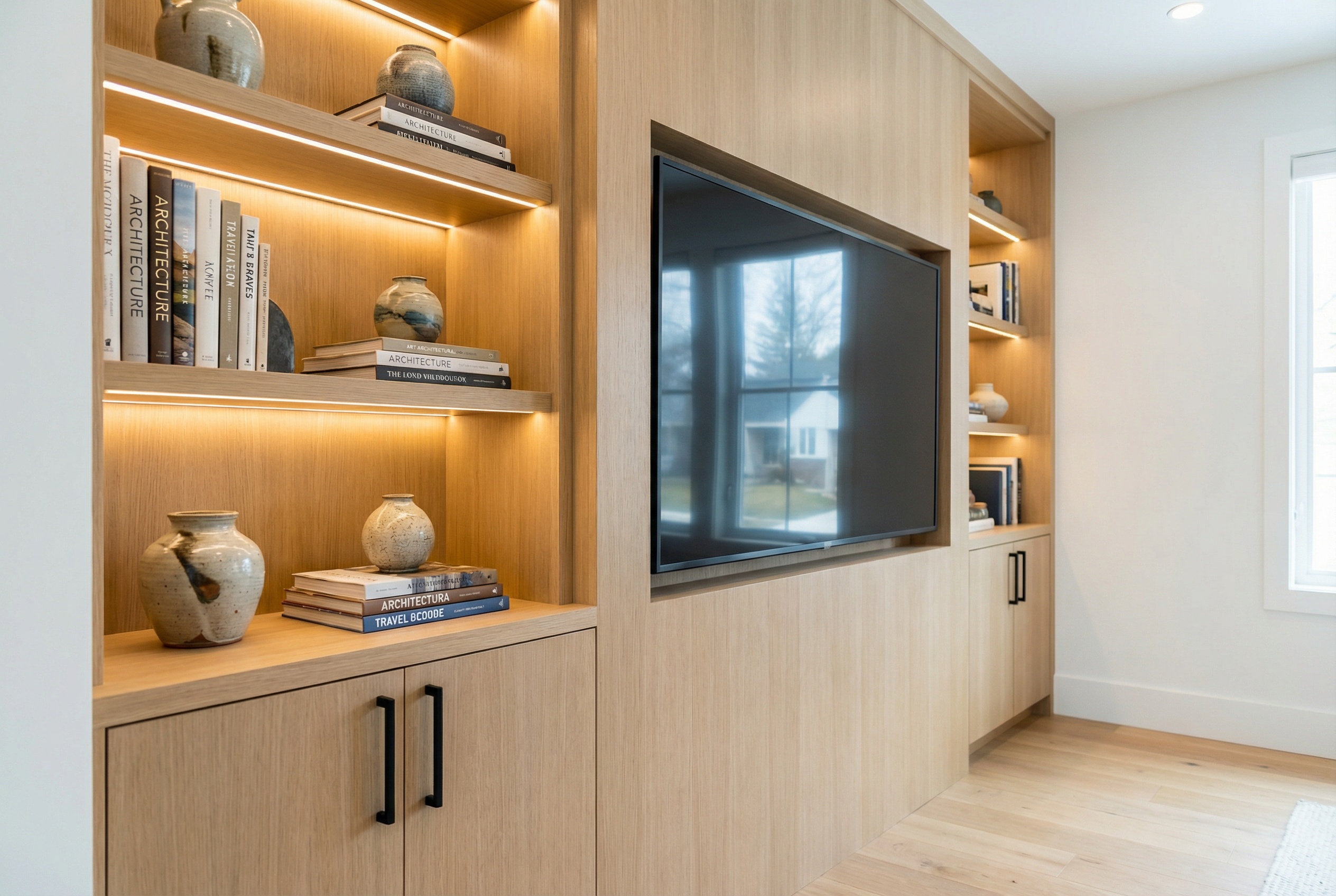
Are Built-In Entertainment Centers Worth It?
The quote comes in and the number gives you pause.
A custom built-in entertainment center costs more than a standalone TV unit. Sometimes significantly more. And if you have never owned one, it is hard to know whether the difference is worth it.
The honest answer is that it depends. Not every home or every situation justifies the investment. But for the right space and the right household, a built-in delivers value that furniture simply cannot match.
This guide breaks down what drives the cost, what you actually get for it, and how to decide whether custom built ins make sense for your home.
Why built-in entertainment centers cost more
Custom built ins are not priced like furniture. They are priced like home improvements.
The difference starts with how they are made. A standalone tv entertainment center comes off a factory floor in standard sizes. A built-in entertainment center gets designed for your specific wall, built to your exact dimensions, and installed as part of the room.
That process involves more time, more skill, and better materials than mass production allows. The cost reflects all three.
It also reflects permanence. A built-in wall unit becomes part of the home. That is a different category of investment than furniture you can return or replace.
What you are actually paying for
The price of a custom entertainment center covers more than materials and labor. Here is what the investment actually includes:
Exact fit: The unit fills your wall precisely. No gaps, no awkward sizing down to the nearest standard option.
Built in storage designed for your life: Gaming consoles, streaming devices, books, media, and decor items all get a dedicated home instead of competing for space.
In-wall cable management: Cords disappear behind the wall entirely. The TV wall looks clean from every angle.
Material quality: Custom builders use solid wood components and quality plywood cores. Most stock furniture uses particleboard and MDF.
Open shelving and storage cabinets balanced for real use: Not just what looks good in a photo, but what works on a regular Tuesday.
A finish matched to your home: The unit looks like it was always part of the room, not placed in front of it.
When built-in entertainment centers are worth it
The investment tends to pay off most in specific situations.
The living room is the main gathering space. If every seat in the room faces the TV wall, that wall sets the tone for the entire space. A well-designed custom entertainment center turns a functional necessity into a defining feature of the room.
Standard furniture has never fit the wall correctly. Gaps, wrong proportions, and sizes that do not quite work are signs the space needs a custom solution. Built in wall units eliminate that problem entirely.
Storage is a constant issue. If gaming consoles, remotes, books, and media have no real home, a built-in with dedicated built in storage solves the problem at the source rather than managing symptoms with extra furniture.
You plan to stay in the home. The longer you live with a built-in, the more value it delivers. Quality construction holds up for decades. Budget furniture rarely does.
The home is going on the market. A custom entertainment wall unit adds visual impact and storage function that buyers notice. It signals a home that has been invested in, not just maintained.
When the investment may not make sense
Being honest about this matters. Custom built ins are not the right call in every situation.
You rent or plan to move within a few years. A built-in improves the property, not your next home. A quality standalone media center is the smarter short-term choice.
The room is a secondary space. A basement TV area or guest room does not need the same level of investment as the main living room. Standard furniture works fine in lower-traffic spaces.
The budget genuinely cannot support it right now. A built-in done well is better than a built-in done cheaply. If the timing is not right, waiting and planning is better than rushing into a build that cuts corners.
The resale value question
Many homeowners wonder whether a custom entertainment center adds resale value. The straightforward answer is yes, but with context.
Built-in storage and cabinetry consistently appeal to buyers. A wall mounted TV inside a floor-to-ceiling entertainment wall unit reads as a finished, move-in-ready home. It reduces the list of things a buyer feels they need to add.
The impact is strongest when the built-in fits the home's style and the room's proportions. A well-executed entertainment wall unit in the main living room adds more perceived value than a poorly proportioned one in a secondary space.
Custom built ins also signal quality throughout the home. Buyers who see one tend to look more favorably at everything else.
How custom construction compares to stock over time
This is the part of the comparison most people skip.
A stock tv entertainment center may cost less today. But stock furniture in high-use spaces tends to wear out. Drawer slides fail. Finishes chip. Particleboard swells. Most budget entertainment units need replacing within five to ten years.
A custom built-in uses joinery methods and materials that last significantly longer. The upfront cost is higher, but the cost per year of use often ends up lower than replacing cheaper furniture twice.
That math changes the conversation. The question is not whether custom costs more. It is whether the total cost over time is actually higher.
Common misconceptions about custom built ins
Custom always means ornate. It does not. Custom means built for your space. Some of the cleanest, most minimal entertainment wall unit designs are fully custom.
Built-ins make it hard to change the room later. In reality, most homeowners who invest in a well-designed built-in stop wanting to change the room. The space finally feels finished.
Stock and custom use the same materials. They rarely do. The difference in construction quality is visible over time, not just on the day of installation.
Key Takeaways
Custom built ins cost more because they are home improvements, not furniture purchases.
The investment covers exact fit, quality materials, built in storage, and cable management.
Built-in entertainment centers are worth it for main living spaces, long-term homeowners, and homes going to market.
They may not make sense for rentals, secondary rooms, or tight budgets with no flexibility.
Custom construction typically lasts longer than stock furniture, which changes the total cost comparison.
Buyers notice built-in cabinetry. It adds real perceived value at resale.
Is a built-in entertainment center the right move for your home?
If you are weighing the investment, a design conversation can help you figure out whether a custom entertainment center makes sense for your space and your goals.
Use our quick form to share your wall dimensions, storage needs, and a few photos. We will help you understand what a custom built-in would look like for your home and whether the investment fits your situation.

